


Soft snow, fuzzy sweaters, cozy nights by the fireplace… Winter is my favorite season! And with the excitement of the holidays approaching, it’s hard not to get swept up in it all. Whether you look forward to the delicious food, the great company, or all the holiday traditions, this time of year is worth the bitter cold that comes with it. (Well, for the Northern Hemisphere, at least!) More »
 1
1
Even our biggest Wolfram|Alpha fans may have missed some of the stories we’ve shared this year—but here’s your chance to catch up! Without further ado, our 10 most popular Wolfram|Alpha Blog posts from 2013 More »
1
It wasn’t all that long ago that I was in high school—and I can still remember that looming dread of mid-terms that comes around this time of year. Getting a head start on studying may seem impossible, but Wolfram|Alpha has plenty of ways to make it a little easier! More »
If you’re a big music fan (and who isn’t?), you’ve probably been carrying around a lot of the lyrics to your favorite songs and albums in your head. It’s unlikely that you get the chance to show off that expertise very often, though–but now’s your chance! Cash in your music knowledge for cool Wolfram prizes in the Alpha Albums contest. More »
1
For many high school seniors, it’s that time of year when the search for colleges is wrapping up—or, for juniors, is just beginning. Whether you’re interested in comparing university stats, finding out how affordable college will be, or comparing your test scores against your peers, Wolfram|Alpha has some valuable tools to help you pick the right school. More »
2
‘Tis the season to inspire your loved ones to unleash their inner computational genius! Get ahead of your holiday shopping with these holiday promotions from Wolfram|Alpha More »
1
The holiday season is upon us again, and that means one thing: more turkey, please. Last year we introduced a tool for calculating how long you should cook a turkey. This year we’ve expanded our selection of useful tools to help you plan your turkey-related needs for the holidays. More »
1
A new partnership between Wolfram Research and the Raspberry Pi Foundation makes the Wolfram Language and Mathematica—the underlying technologies for Wolfram|Alpha—available on the Raspbian OS and they will soon be bundled as part of the standard system software for every Raspberry Pi computer. More »
Was that painted by Monet or Manet? There are some people in the world who just know these things. Those walking, talking encyclopedias of artistic knowledge who can rattle off movements and time periods like I rattle off Maxwell’s equations and characters from Breaking Bad. My old college roommate, for example, was one of those brainy people. She could determine a Degas painting simply from the brush strokes. Meanwhile, I can barely remember what my own handwriting looks like. More »
I’ll admit that I am an awful singer, who also happens to sing a lot. But, oddly enough, there aren’t many songs that I know all the words to by heart. When I sing along to one of my favorite songs, I tend to fill in the blanks with plenty of hmms, hums, and other nonsensical gibberish. The end result can be both hilarious and excruciating to hear. More »
10
Computational knowledge. Symbolic programming. Algorithm automation. Dynamic interactivity. Natural language. Computable documents. The cloud. Connected devices. Symbolic ontology. Algorithm discovery. These are all things we’ve been energetically working on—mostly for years—in the context of Wolfram|Alpha, Mathematica, CDF and so on. More »
1
I was a raging sugar-holic as a kid. (Let’s face it, who wasn’t?) So, naturally, Halloween was a glorious, much-anticipated, high-energy free-for-all. My brother and I used to return from trick-or-treating dragging heavy pumpkin buckets and overstuffed pillowcases behind us—the candy wrappers would make that crinkle-squish sound as we dumped out our riches to sort, trade, construct giant candy pyramids… and then devour. More »
2
We’re excited to introduce some brand new features to our step-by-step functionality! Wolfram|Alpha can now guide you through factoring polynomials and completing the square, in addition to being updated to include FOIL and the binomial expansion theorem. Let’s take a look. More »
Theodore Roosevelt was born 155 years ago yesterday. Roosevelt led an exciting life—he commanded the Rough Riders during the Spanish-American War, gave a 90-minute speech after being shot, and, oh yes, served as president from 1901 to 1909. As you might expect, Wolfram|Alpha contains quite a lot of data on the life of this impressive figure. More »
By now, most of you students are likely getting into the thick of the academic year, preparing for the first wave of exams and projects and presentations to come your way… But don’t freak out just yet! Here’s a list of Wolfram’s most recent apps and programs that might help make your life a little easier. After all, it never hurts to have a few powerful resources on your side. More »
6
Getting answers just got a whole lot easier for the BlackBerry set. As mentioned at the recent Wolfram Technology Conference, we’re happy and excited to share that BlackBerry has selected Wolfram|Alpha to provide answers for its Voice Control feature with the 10.2 release of BlackBerry OS. More »
10
We are proud to announce Wolfram Problem Generator, a website where students decide which topic they want to practice and we provide the questions and solutions. This is an exciting new way to help students with their classes: previously, students provided their own practice questions and Wolfram|Alpha helped them find answers with Step-by-step solutions. Students can now ask Wolfram|Alpha for help with practice and homework questions and can do practice problems with Wolfram Problem Generator. More »
7
Did you know that October 11 is World Egg Day?
Like most people, you probably go to the grocery store and eventually end up in the dairy aisle, where, unless you’re a vegetarian or vegan, you probably pick out a dozen eggs and place them into your cart without a second thought. They’re pretty much a staple food—from savory breakfasts to the sweet wonders of baking. More »
20
Psst! Wolfram|Alpha has updated its Pokémon data to include Generation VI. Check it out here.
It’s not all abstract algebra and organic chemistry here at Wolfram HQ. From time to time, we like to take a piece of pop culture and put our own spin on the subject. We’ve seen from our server logs that our Pokémon plane curves are pretty popular. Pokémon X and Pokémon Y, the latest installments in the long-running video game series, will be released on October 12. Given those two facts, we thought it was a good time to add data about Pokémon to Wolfram|Alpha. More »
Bonding is pretty fundamental, as it determines the shape of a molecule, which in turn determines how a molecule behaves. Wolfram|Alpha now supports Lewis structures—diagrams that show both the bonded and unbonded electrons in a molecule. But as any good teacher will tell you, even more important than finding the answer is the procedure used to get that answer. Thus, Wolfram|Alpha is expanding its Step-by-step interface into the realm of chemical bonding (with even more Step-by-step functionality coming soon). More »
2
A lot of cool things happened this summer on Wolfram|Alpha and the Wolfram|Alpha Blog. And just wait—we have even better stuff planned for the coming months! But in case you missed it, here’s a quick recap of some of our best posts from this summer. More »
To celebrate the start of the school year last month, Wolfram|Alpha launched the Set the Curve Contest, where we gave fans a chance to prove they were the nerdiest Wolfram|Alpha user by sharing their word clouds from Facebook Personal Analytics. Our winner would be immortalized in Wolfram|Alpha with the chance to choose a person or figure to be portrayed as our next mathematical curve. More »
The NFL season is in full swing, and along with rooting for one’s favorite team come the highs and lows of fantasy football. For those uninitiated in the fantasy football society, it’s a fairly easy concept: draft a team of NFL players that you think will produce the best statistics each week. More »
4
Recently the author of xkcd, Randall Munroe, was asked the question of how long it would be necessary for someone to fall in order to jump out of an airplane, fill a large balloon with helium while falling, and land safely. Randall unfortunately ran into some difficulties with completing his calculation, including getting his IP address banned by Wolfram|Alpha. (No worries: we received his request and have already fixed that.) More »
Happy Hispanic Heritage month! To celebrate, Wolfram|Alpha would like to spread some Hispanic computational knowledge! We’ve got some pretty nifty geographical gems to show you. More »
1
As a physics major, I sometimes find myself solving interesting problems for fun. However, I have never been very quick at doing simple math in my head, so I often resort to using computers to do tedious calculations. This keeps me interested in the answer to the problem and not focused on the details of the calculations, which can be very boring. Computers are much faster at doing calculations than I am, and Wolfram|Alpha is no exception: for instance, arctan(3^4^3)/pi. More »
1
As part of our ongoing plan to expand Wolfram|Alpha’s numerical method functionality to more kinds of algorithms, we recently addressed solving differential equations. There are a number of different numerical methods available for calculating solutions, the most common of which are the Runge–Kutta methods. This family of algorithms can be used to approximate the solutions of ordinary differential equations. More »
We’re pleased to announce that computerbasedmath.org is partnering with UNICEF for the third Computer-Based Math™ Education Summit. More »
Each summer a group of interns arrives at Wolfram Research to work on a host of exciting projects that not only prepare them for their future careers, but also give them the opportunity to make some great contributions to Wolfram technologies. One such contribution this year was the “Fun Curves” project for Wolfram|Alpha that took drawings of famous cartoon characters and turned them into mathematical equations. More »
Though summer’s winding down in the Northern Hemisphere, it’s not too late to take a trip out to your local amusement park. We’ve added a bunch of new amusement park data to Wolfram|Alpha, so whether you’re plotting your vacation or just hoping to learn some cool facts about your favorite rides, we’re sure to have a query that’ll give you a thrill. More »
2
For many of us, the end of summer is a time of change. You might be going to college, starting a new year of school, or taking a new job. Even if you’re not, there’s a decent chance that you’re still meeting some new friends and living a little bit differently in general. We’ve previously looked at what Wolfram|Alpha Personal Analytics for Facebook can tell us about the evolution of our society, but we can also use Personal Analytics to inform us about how we change over time as individuals. More »
The Wolfram Education Team is going all over the United States and even online this fall semester. We are excited to demonstrate new advances in Wolfram technologies and their applications in the classroom.

(This is the third post in a three-part series about electrostatic and magnetostatic problems involving sharp edges.)
In the first blog post of this series, we looked at magnetic field configurations of piecewise straight wires. In the second post, we discussed charged cubes and orbits of test particles in their electric field. Today we will look at magnetic systems, concretely, mainly at a rectangular bar magnet with uniform magnetization. More »
1
Heading back to school means stocking up on all the necessary supplies: books, pens, and Wolfram Course Assistant Apps! Whether you’re taking multivariable calculus or music theory, there’s a good chance that we have a Wolfram Course Assistant that’s perfect for you. More »
5
Like many people, I went to see the movie Elysium last weekend. The movie’s premise is that the wealthy members of society have relocated to an orbital space station, named Elysium, that circles the Earth while the rest of humanity is stuck on a seemingly dying world.
Focusing on the science of the movie, what can Mathematica and Wolfram|Alpha tell us about the space station and some of the other events portrayed? More »
19
We here at Wolfram are, by and large, a bunch of nerds. This shouldn’t be that surprising, especially after looking at the people and fictional characters we’ve turned into mathematical curves on Wolfram|Alpha. Our curves of internet memes, cartoon and video game characters, celebrities, and mathematical formulas have been incredibly popular. As many of our fellow nerds get ready to go back to school, we’re celebrating nerddom and showing our appreciation for Wolfram’s users—by letting one of you decide the next curve to be featured in Wolfram|Alpha. More »
3
Thirty-three extremely intelligent high school students gathered at Bentley University July 7-19 to participate in our second annual Mathematica Summer Camp. The program lasted two weeks, and within this small window of time, students created their very own Mathematica projects. More »
4
When 11-year-old Jesse Friedman won a programming prize at the Wolfram Technology Conference last year, I pondered the diversity of our global user community—from children to Nobel Prize laureates, from CTOs to astronauts, to the thousands of people on the planet who help the world tick every day using the tools we make. More »
As we congratulate Prince William and Catherine, Duchess of Cambridge (AKA, Kate Middleton) on the birth of their first son, we thought it’d be fun to explore some royal names, among other data, on Wolfram|Alpha, and see what impact the royal baby could end up having on the American side of the pond. More »
3
2
As we continue to expand the functionality of Wolfram|Alpha, we want to include not only the symbolic and exact results, but also allow you the option to explore the numerical approximations for solving mathematical problems such as differential equations and integrals. These methods, both simple and complex, continue to underpin many of our modern day calculations. More »
5
Even if you’re a pretty big word nut, you may not think of Wolfram|Alpha as your go-to source for learning more about the English lexicon. You might be surprised, then, by the discoveries and computations that you can make with Wolfram|Alpha’s word data. More »
“At breakfast time I was sitting by the house at Vanavara Trading Post, facing north…. I suddenly saw that directly to the north, over Onkoul’s Tunguska Road, the sky split in two and fire appeared high and wide over the forest. The split in the sky grew larger, and the entire northern side was covered with fire. At that moment I became so hot that I couldn’t bear it, as if my shirt was on fire; from the northern side, where the fire was, came strong heat. More »
8
Last year we greatly expanded our step-by-step functionality for mathematical problems in Wolfram|Alpha. These tools can be a great aid for students to understand the methods of solving integrals and equations symbolically. But what if we are not looking for a symbolic result? What if we need a numerical approximation? For example, we might be looking at an integral or differential equation that cannot be solved in a closed form, or we might just want to find where an equation intercepts the x axis. More »
1
Wolfram|Alpha apps are your guide to summer! Whether you’re interested in sunbathing, traveling, boating, stargazing, or fitness, we have an app for you. More »
2
In my last blog post, I discussed how to construct closed-form trigonometric formulas for sketches of people’s faces. Using similar techniques, Wolfram|Alpha has recently added a collection of hundreds of such closed-form curves for faces, shapes, animals, logos, and signatures. More »
1
Recently, we’ve been showcasing some new math features in Wolfram|Alpha, particularly those relevant to primary and secondary school students. Our idea is that when using Wolfram|Alpha, learning math can be a fun experiment. We’d like you to think of Wolfram|Alpha as your own infinitely patient robot, which you can use to explore mathematical ideas, test your knowledge, and generally answer any specific math question you have. More »
5
Here at Wolfram Research and at Wolfram|Alpha we love mathematics and computations. Our favorite topics are algorithms, followed by formulas and equations. More »
Mathematics has many faces. It deals with diverse objects such as integers, points and lines, equations, graphs, categories, thousands of different spaces (from R3 to Hilbert, Banach, Fréchet, …), and so on. Mathematics can be constructive or just prove the existence of certain structures. Wolfram|Alpha has made a good fraction of computable constructive mathematics freely available to everyone: from line through (2,3) and (4, 5) to Fréchet derivative of (integrate exp(-f(x)^2) dx from -inf to inf) wrt f(y) to fractional derivative of ln(z). More »
6
A century ago, Srinivasa Ramanujan and G. H. Hardy started a famous correspondence about mathematics so amazing that Hardy described it as “scarcely possible to believe.” On May 1, 1913, Ramanujan was given a permanent position at the University of Cambridge. Five years and a day later, he became a Fellow of the Royal Society, then the most prestigious scientific group in the world. In 1919 Ramanujan was deathly ill while on a long ride back to India, from February 27 to March 13 on the steamship Nagoya. More »
Some common questions from the many student users of Wolfram|Alpha include “Isn’t cbrt(-8) = -2?” and “Why doesn’t the plot of the cube root include the negative part?” The answers are that -2 is just one of the three cube roots of -8, and that Mathematica, the computational engine of Wolfram|Alpha, has always chosen the principal root, which is complex valued. More generally, odd roots of negative numbers are typically assumed to be complex. You can see this in the output of (-8)^(1/3). More »
6
More than a million people have now used our Wolfram|Alpha Personal Analytics for Facebook. And as part of our latest update, in addition to collecting some anonymized statistics, we launched a Data Donor program that allows people to contribute detailed data to us for research purposes. More »
15
I love dogs; they are the best. I find that they are suitable not only as companions, but as friends and confidants. That said, as much as I might anthropomorphize them, I do genuinely wish I could see the world in their eyes. Now, with Wolfram|Alpha, I can—and so can you. More »
My mother always loved gardening, and when I was growing up I enjoyed taking long strolls with her while she told me what all the different flowers were. She knew a lot about plants, but I remember sometimes asking her a question—like what was a plant’s taxonomic structure, or its optimal height compared to its average height—and she didn’t know what to say. Well, that’s why we’ve come up with the Wolfram Plants Reference App, available on iOS and PC. This app is for you, mom! More »
1
The 77th Masters Tournament begins today at Augusta National Golf Club. Many commentators think Tiger Woods is poised to score his fifth win (his last was in 2005), but strong challengers abound. More »
3
Now available on Android devices via the Google Play store, the Wolfram Algebra Course Assistant and Wolfram Calculus Course Assistant are part of the equation for academic success. More »
1
It’s tornado season in some parts of the United States, and while longtime users of Wolfram|Alpha are probably aware of our ability to analyze earthquake data, we weren’t able to say much about tornadoes. Now, utilizing data from from NOAA’s Storm Prediction Center, Wolfram|Alpha can answer questions about tornado activity in the US from 1950 to 2012. For good measure, we’ve also added data on worldwide volcanic eruptions to our knowledge base. More »
10

Today, we’re proud to unveil the Wolfram|Alpha Handwritten Knowledge Engine, a new, more personal way of delivering computed answers.
You might be wondering where this idea came from. Well, let me tell you a story.
We had a thought not long ago that it would be nice to get you (the internet) a gift. One of those “just because” things to spread a bit of happiness around the world.
Conventional wisdom holds that the best gifts are handmade. But making gifts by hand for over 2.2 billion people? It was a daunting challenge. Luckily, we had a head start: Wolfram|Alpha already computes its answers just for you. The answer to every query, question, and computation is custom-generated, drawing upon trillions of pieces of built-in knowledge.
We began to imagine ways to add that handmade, personal flair to Wolfram|Alpha results. Artisanal answers, if you will. We narrowed it down to “putting a bird on it” versus a handwritten interface, results pages and all. Handwriting won the coin toss.
You remember handwriting, right? The thing you used to do with a pen, to write letters and checks? Checks, well, they were these pieces of paper that represented… you know what, I should get back to the story.
We knew we’d need a goodly number of contributors, as well as some sort of training component—consistency is important, after all. Human Resources began recruiting in earnest (by the way, we’re hiring), as well as organizing a Corporate Penmanship Retreat.
That brings us to now. The retreat just wrapped, and the Wolfram|Alpha Handwritten Knowledge Engine is ready to go. Ask a question, and your machine-computed results will be transcribed and illustrated by a real live human being.
I recommend acting fast. A few of the physicists already have writer’s cramp, and the pop culture researchers might be next.
So what will you compute? I definitely cannot recommend running your homework through Wolfram|Alpha, printing out the handwritten results, and trying to pass them as your own. Definitely not. But here are some other ideas to get you going.
Go meta, and get handwritten knowledge about the word handwriting:
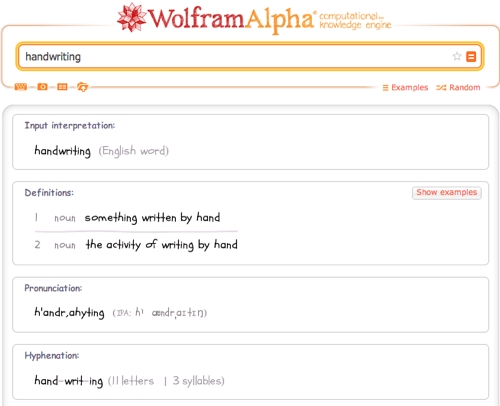
Find derivatives… with style:

Put your mind at ease with a handwritten verification of some important information:

Why not Zoidberg?

We hope you enjoy the Wolfram|Alpha Handwritten Knowledge Engine. Please share your favorites in the comments.
April 2, 2013 Update: We hope you enjoyed the handwritten Wolfram|Alpha results on April Fools’ Day. While some staff are recovering from carpal tunnel, we have returned to the normal styling for all results.
If you want to see the handwritten results, begin any query with “handwritten style” (without quotes), and our staff will get back to work!
1
Many of us are familiar with motion in a straight line: you speed up and move faster, you travel forward and end up someplace new. But there is another type of motion: angular motion, or the motion in a circular path. These are the kinematics of a merry-go-round, a spinning top, or the orbit and rotation of the Earth. More »
It’s that time of year again! Time to apply for the Mathematica Summer Camp 2013! The camp is being held at Bentley University in Waltham, Massachusetts, July 7–19. Students will have the opportunity to learn Mathematica’s computing language, work with Wolfram mentors, and interact with other students with similar interests. By the end of camp, each student will have created his or her very own Mathematica program! More »
5
I’m not a doctor, but for the purpose of this blog post, please imagine that I am wearing a lab coat and a stethoscope—maybe even two stethoscopes, just to be extra professional. Wolfram|Alpha now has an understanding of sig codes, which are the marks on your drug prescriptions that tell the pharmacist what it is you’re getting, what it does, and when precisely it should be taken. Patients aren’t often exposed to sig codes these days, but pharmacy techs learn them, since they receive these abbreviated instructions from the doctor. More »
9
Throughout the history of physics, scientists have postulated laws and theories about the nature of the world around them. Some were proven false, while others have grown to be the basis of entire fields of study. One such field is classical mechanics, which describes the area of physics most familiar to us, that of the motion of macroscopic objects, from baseballs to planets and traveling along hills to falling from space. As one of the oldest subjects in science, the work here serves as a basis for less familiar areas such as relativity and quantum mechanics. More »
Today is National Tooth Fairy Day, a day where we can be reminded to take good care of our teeth, and in the event we’re young and some fall out, to put them under our pillows for magic money. I once heard that the source of this magic money is from some sort of self-described guardian, but I’ve never actually met him or her. More »
2
Superlatives, like hyperbole, are my favorite thing. So it is with the greatest excitement that I am devoting this blog post to superlatives and range searching, as Wolfram|Alpha has again expanded its functionality in these areas.
I once heard from an actor pretending to be a scientist that the denser an element is, the better that element is for fighting terrible monsters. I cannot speak on the accuracy of that statement, as I am not an actor pretending to be a scientist, but if you wanted to apply superlatives to chemistry, Wolfram|Alpha can do that. More »
3
Years ago when I was young,
there was something I wanted to know:
“Could math ever be super popular,
or has it begun to plateau?”
Although being “smart” and quite “witty,”
I never could figure math out.
Its numbers were letters, its letters were prime,
I wanted to stand up and shout. More »
7
In our previous post about expanding Step-by-step solutions, we introduced a revamped equation solver. I’m proud to say that it has now been extended to solve systems of linear equations. In addition, you have four different methods to choose from when looking for a solution! These methods are elimination, substitution, Gaussian elimination, and Cramer’s rule. Let’s look at x + y = 5, x – y = 1 to see all four methods in action. More »
2
I just got a flat tire and I need to replace it with a new one. What size tire do I need to get? This can be a tricky question, and many of us would just take our cars into a dealership or repair shop and let them deal with it. But it’s not as hard as you might think, and now Wolfram|Alpha provides tools to help you understand tire sizes. More »
This Sunday, the Baltimore Ravens and the San Francisco 49ers are going to play against each other in Super Bowl XLVII, which takes place in New Orleans. So what do we know about the teams and their histories, and what can we determine from their statistics this season? More »
1
Tools are a natural extension of our mastery of physics. By putting our knowledge to use, we are able to manipulate the world around us on a much larger scale. Tools and machines have allowed us to build great monuments, to settle otherwise inhospitable locations, and to launch ourselves into space. More »
As a continuation of our new math content blog series, I’d like to talk about an exciting new Step-by-step feature. Previously I talked about differential equations, but today I’d like to look toward the other end of the spectrum: basic arithmetic. Wolfram|Alpha can now help you work out long addition, subtraction, multiplication, and division with hints and steps! Let’s go ahead and look at some examples. More »
2
Football, basketball, and baseball have two common elements. The first, each sport is the “best” depending on which one I’m watching at a given moment. The second, each sport’s raw data can now be computed and juxtaposed in Wolfram|Alpha, which means arguments over statistics, histories, and comparisons will be better than ever before. More »
25
Today we’re excited to announce the first upgrade to Wolfram|Alpha’s Personal Analytics for Facebook. There’s much more to analyze, see, and do—here’s a quick look! More »
4
Wolfram|Alpha has released a suite of apps that cover all of your financial needs. The apps are profoundly powerful tools, allowing you to stay informed about your business’s finances and the marketplace at large while in the office or on the go. More »
6
The Wolfram|Alpha math team adds new and exciting content to Wolfram|Alpha on a daily basis! In fact, over the past few months we’ve added a wide range of features and we will be introducing them in a blog series here. Lately, we’ve made an effort to make Wolfram|Alpha a powerful learning tool for those learning arithmetic! If you are either teaching or learning addition, multiplication, or basic math word problems, Wolfram|Alpha can help you. More »
10
When I was younger, I held the naive and incorrect view that mathematics was divorced from the arts. As I’ve gotten older, I’ve become more aware of not only how mathematics is the foundation for any of the hard sciences, but also how it is intrinsically linked to essentially any form of creativity. Certainly users of our Wolfram Music Theory Course Assistant could have told me that, but I’m not just referring to music. In truth, I’m not even trying to make some highbrow appeal to abstract art, either, although I happen to rather like that sort of thing. What I’m trying to say is that mathematical equations can make pretty pictures.
