


 2
2
My family lives all over, with varying worldviews and equally varied career choices, from video game producers to truck drivers. So certainly reconnecting with family, both nuclear and extended, can be a daunting holiday experience. But don’t fret—Wolfram|Alpha is here to sort you out with the perfect ice breakers.
Suppose your brother is a truck driver who plans to move to Salt Lake City, Utah, from Raleigh, North Carolina, citing dissatisfaction with his wages and the cost of fuel, and how they juxtapose to the cost of living in Raleigh. You could first show how many truck drivers are in North Carolina and Utah, and from there ask the question “What is the average wage for truck drivers in North Carolina and Utah?”
We can see that truck drivers do earn more money in Utah than in North Carolina, and the price of diesel is, at the time of this writing, pretty much the same—only a few cents difference. But moving to another part of the country is a huge decision, and even if one can earn a few thousand dollars more, is it worth it? We could compare the cost of utilities in Salt Lake City and Raleigh or, more generally, the cost of living in Salt Lake City and Raleigh. More »

Searching for that perfect gift? Here’s a stocking stuffer to fulfill anyone’s wish list: Wolfram|Alpha Pro. The supreme Wolfram|Alpha experience is now available in 3-, 6-, and 12-month gift subscriptions. More »
The Nobel Prizes, named for chemist and engineer Alfred Nobel, inventor of dynamite and activist for humankind’s advancement, were handed out in Stockholm today. Wolfram|Alpha can tell us that the winners include Brian Kobilka and Robert Lefkowitz for the Nobel Prize in Chemistry.
 5
5
So, you forgot your anniversary was coming up, and now you have to decide what you’re going to get your loved one. Wolfram|Alpha can now help point you in the right direction. The stereotypical anniversary gift for a man to give his wife is often thought to be jewelry, but you would be surprised to know that many traditional and modern wedding gifts have nothing to do with jewelry.
 6
6
On November 28, 1964, the Mariner 4 spacecraft was launched. It continued on toward Mars and was the first probe to return close range images of that planet. As a result of this successful mission, November 28 is known as Red Planet Day. So let’s take a few minutes to learn a bit about Mars.
The planet Mars has been known since antiquity, and its rusty color gave our ancestors the idea that it was associated with blood and, by extension, the god of war.
In more modern times, the telescope was used to try to study Mars. One notable scientist was Giovanni Schiaparelli. Because Mars, even when at its closest to Earth, appears much smaller than the Moon (about 1.3% the apparent size of the Moon), it is difficult to see detail on Mars from Earth. When humans look at something near its resolution limit, the brain tends to “fill in the gaps” and create optical illusions of lines and features that aren’t really there. Schiaparelli used the word “canali” to describe some of the lines he thought he saw. The word “canali” means “channel,” and due to a mistranslation, was translated as “canals.” Suddenly Mars had canals and the speculation about life on Mars began. Intelligent lifeforms were struggling to survive on the dry desert world and must have built canals to funnel water from the polar caps to survive. More »
If I may be so bold as to make a value judgment, kids are—if nothing else—totally super awesome. A little over two years ago, we wrote a blog post entitled “10 Fun Questions Kids Can Answer with Wolfram|Alpha.” Since then, however, our blogs have focused on expanded functionality, socioeconomic data, sports data, and all sorts of things that are really cool but, truthfully, geared toward people whose ages are in the double digits. Luckily, Wolfram|Alpha can compute answers to all sorts of queries kids (or people who self-identify as kids) have, too.
So let’s start out with dinosaurs. I recently learned that the brontosaurus is formally called an apatosaurus. Wolfram|Alpha knows that not everyone knows that, though, so if we query “Compare T-Rex, Brontosaurus,” we get information on both Tyrannosaurus Rex and Apatosaurus. “They never saurus coming!” you could say. The apatosaurus is potentially twice as long as the T-Rex, and weighs several times as much—but curiously enough, the public is more interested in the T-Rex, as evidenced by how many more times its Wikipedia page is queried. More »
Since President Reagan declared it in 1987, every third week in November in the United States is celebrated as Geography Awareness Week. Related to that, one of my favorite novels—Anna Karenina, by Leo Tolstoy—is coming to cinemas today. Thanks to Wolfram|Alpha, I’ll be able to discuss these two seemingly unrelated things with you. My nerdy dream has finally come true.
If you’re unfamiliar with Anna Karenina, I won’t spoil the content, but suffice it to say that Anna is a Russian socialite and aristocrat whose lover, Count Alexei Vronsky, due to various reasons best discovered on your own, takes her across Europe, later returning to Russia. There’s a lot of discussion about ethics and morality, with some deeply flawed characters making interesting if non-ideal decisions, to say the least. What matters for this blog post, though, is that Anna visits a bunch of places. And she’s from Russia, which is huge. It’s about the size of Pluto. More »
Recently we asked educators who use Wolfram|Alpha to participate in our contest and tell us their story. After spending the last few weeks sifting through entries, our Education Outreach team has finally chosen a winner. A very sincere congratulations to Christopher Benshoof in Fairbanks, Alaska, a teacher at Lathrop High School! More »
This week is American Education Week (November 11–17), and in a very fundamental way, our goal as a company is to improve educational standards and accessibility around the world with our technology. For over 20 years, Wolfram Research has been at the forefront of combining technology with education. It started with Mathematica and grew with Wolfram|Alpha, mobile apps, the Wolfram Demonstrations Project, Wolfram SystemModeler, and much more. From simple elementary math to highly complex physics, Wolfram’s tools are used not only around the nation, but around the whole world. More »
3
Comets are a fascinating area of astronomy that holds a special place in the hearts of the public, not just astronomers. This fact mainly holds due to the potential for a new comet to become visible to the naked eye, a rather uncommon event. Maybe the same mechanism that keeps this fascination going in the public is the same one that makes gamblers keep going back to the poker table. Usually, you will lose at gambling, but every now and then you might win big. In a way, the same holds for comets. More »
The US elections are over, and with a few exceptions, we can now answer the question “What happened?” We know who won the 2012 presidential election, we know there was an upset in the Massachusetts senate race, and we know that Republicans maintained control of the House of Representatives. So now, whatever race you’re most concerned about, the big question is, “Why did it happen?” More »
At 2am on Sunday, November 4, the United States (sans Arizona and Hawaii, which are special) will end daylight saving time. The result is that Americans will essentially “gain” an hour. I thought it would make for a fun blog post to tell you about what you could potentially do with your extra hour, in part because none of my real-life friends would listen to me. More »
1
Culinary fortitude is not merely creating extravagant or exotic food. It’s not just the massive amount of hours you’ve spent on Foodgawker and TasteSpotting drooling over perfectly photographed morsels set on pretty little dishes. It goes far beyond the fact that you can, or know of someone who can, eat a raw bird’s eye chili and not have to drink three glasses of cold milk afterward. Culinary fortitude comes down to numbers. At Wolfram|Alpha, we do numbers best. More »
To celebrate Halloween, last year we discussed what you can do with 1,818 pounds of pumpkin. It was a popular blog post, and it put an awful lot of smiles on peoples’ faces. An entire lamina (filled shape) of smiles, in fact. More »
We’re huge library fans here at Wolfram|Alpha. We proudly count a number of former librarians and library science experts among our ranks, and we rely heavily on contacts at public and academic libraries for expert assistance in locating sources and answering difficult questions across a wide range of knowledge areas. So we hope that, like us, you’ve been celebrating National Friends of Libraries Week (October 21–27) the past few days. More »
2
Today is National Mole Day. Unlike most of Wolfram|Alpha’s team I’m not a scientist, so if you’re curious to learn what the day is about, so am I—we can learn together! Thankfully, Wolfram|Alpha is a great tool for learning pretty much anything.
11
Wolfram|Alpha answers millions of queries every day. For instance:
1
This is an edited version of a short talk I gave last weekend at The Nantucket Project—a fascinatingly eclectic event held on an island that I happen to have been visiting every summer for the past dozen years.
Lots of things have happened in the world in the past 100 years. But I think in the long view of history one thing will end up standing out among all others: this has been the century when the idea of computation emerged. More »
1
First, my apologies: I didn’t quite follow through on my promise of a regular series of blog posts about American Community Survey data in Wolfram|Alpha. But when you’re trying to ingest all the world’s systematic knowledge… well, there’s a lot of competition for the top spot on your to-do list. So to make up for lost time, I’ll cover the remaining clusters of ACS data that you can currently explore in Wolfram|Alpha: education and income. More »
Today is World Teachers’ Day, and our recent blog post about Wolfram|Alpha in the classroom inspired me, so I thought I’d share how I used Wolfram|Alpha when I was an English as a second language (ESL) teacher in Korea. More »
55
What do the following two math problems have in common?
- If I have 12 apples, and Jane has 7, and then Jane gives 2 apples to me, how many more apples do I have than Jane?
- (12 + 2) – (7 – 2)
Answer: two things, actually. More »
2
Last weekend, Looper came out in theaters, bringing time travel back to the big screen. But there are lot of questions that can be asked about the science of the world it portrays. We will visit some minor spoilers along the way, so you may want to wait to read this post until you see the movie. In addition to time travel, Looper depicts widespread solar power and almost ubiquitous telekinesis. What can Wolfram|Alpha tell us about this and other aspects of the film? More »
3
In my last blog post, we looked at various examples of electrostatic potentials and magnetostatic fields. We ended with a rectangular current loop. Electrostatic and magnetostatic potentials for squares, cubes, and cuboids typically contain only elementary functions, but the expressions themselves are often quite large compared with simple systems with radial symmetry. In the following, we will discuss some 3D charge configurations that have sharp edges. More »
25
Step-by-step solutions, one of the most popular features for mathematics in Wolfram|Alpha, has just received a dramatic expansion in its functionality! With our new interface, you now have the ability to walk through all of our Step-by-step solutions at your own pace, revealing only one step at a time. Some of our programs will offer to guide you with hints when walking through solutions. And for common math problems, we can even show multiple ways to find the solutions. More »
6
If you’re a chemist, a student, a mad scientist bent on destroying the earth for irrational reasons, an enlightened scientist bent on saving the population from the mad one, or as understandably enthused about isotopes and radiation as we are at Wolfram, then you’ll love the new Wolfram Isotopes Reference App and Wolfram Radiation Protection Reference App. Released for $4.99 and $9.99, respectively, for the iPod touch, iPhone, iPad, and PC, the apps are arguably the most comprehensive set of tools for the topics so far. More »
1
Recently we released the new Wolfram Geography Course Assistant App for iPhone, iPod touch, iPad, and PCs. Whether you’re studying for an exam or merely a geography nerd like me, there’s no better way to get either a general overview of the planet we all share or a really in-depth analysis of specific datasets. You can study Earth’s physical geography, geology and climate, political boundaries, demographics, economics, and social statistics. It might be the best $4.99 you’ve ever spent, and to prove it, allow me to attempt a persuasive argument. More »
1
Most of the new features we announce on this blog are large-scale projects where we add a huge chunk of data to Wolfram|Alpha all at once. But there are always dozens of background projects going on at any given time—including a seemingly never-ending effort to expand our database of information on private companies.
1
Attention all educators! Tell us how you use Wolfram|Alpha for a chance to win an iPad and a slew of Wolfram|Alpha-powered apps, PLUS a year’s subscription to Wolfram|Alpha Pro!
49
Note added: Since this blog was written, Facebook has modified their API to make much less information available about Facebook friends. While I think adding privacy controls is a good idea, what Facebook has done reduces the richness of the results that Wolfram|Alpha Personal Analytics can give for Facebook users.
After I wrote about doing personal analytics with data I’ve collected about myself, many people asked how they could do similar things themselves.
Now of course most people haven’t been doing the kind of data collecting that I’ve been doing for the past couple of decades. But these days a lot of people do have a rich source of data about themselves: their Facebook histories. More »
6
While Wolfram|Alpha can do many sorts of computations, mathematical calculations are one of its particular specialties. In fact, using the power of Mathematica‘s computational capabilities under the hood, Wolfram|Alpha can do many things, ranging from the very simple to the fiendishly complicated, with mathematical functions. More »
14
In a previous post, I discussed Wolfram|Alpha’s facility with probability distributions, such as the distribution of probability among the possible totals that can be shown with a pair of fair dice: More »
11
Like many people, I went to see Total Recall recently. Much of the story for this science fiction thriller (based loosely on a short story by Philip K. Dick) concerns “The Fall.” As explained in the introduction for the movie, “The Fall” is a tunnel bored through the center of the Earth that connects the fictional United Federation of Britain and The Colony, which is located in present day Australia. More »
August 8 is “National Dollar Day,” commemorating the establishment of the US monetary system on this day in 1786. But the first dollar bill wasn’t issued until 1862—and instead of George Washington, it featured a portrait of Salmon P. Chase, then Secretary of the Treasury under President Lincoln (and later Chief Justice of the Supreme Court). More »
5
Today we are introducing our new Clip ’n Share feature. Wolfram|Alpha users can now easily share individual result pods on their favorite social networks.
When you hover over a result pod, an icon tray featuring Wolfram|Alpha Pro functionality will appear. The brand new Clip ‘n Share feature, which is free and easy for anyone to use, is now included at the end of the icon list. More »
2
Imagine you want to send a one-ton package to Mars, land it safely on the surface, and have it move around after it lands. First, the package has to survive atmospheric entry on Mars, which heats the package to 1,600 degrees. After this, the package has to deploy a supersonic parachute capable of withstanding 9 gs of force to slow down. More »
2
The 2012 Olympics are here, and surely between those moments of watching athletes perform fantastic maneuvers, shatter world records, and generally inspire us all as we recognize just what exactly human beings are capable of, you may say to yourself: “I wonder how I can use Wolfram|Alpha in a conversation about sports?” Luckily, we’re all big sports fans, and since the outcome of events is so often determined by inches or fractions of seconds, it is crucial that every object used conforms to certain standards. More »
4
Wolfram|Alpha’s goal is to cover all things computational, from mathematics and the sciences to movies and sports. But the set of all things computable encompasses areas outside of the real world as well. With the 25th anniversary of Star Trek: The Next Generation coming up, we can now compute the relationship between warp factors and the speed of light. More »
5
(This is the first post in a three-part series about electrostatic and magnetostatic problems involving sharp edges.)
Mathematica can do a lot of different computations. Easy and complicated ones, numeric and symbolic ones, applied and theoretical ones, small and large ones. All by carrying out a Mathematica program.
Wolfram|Alpha too carries out a lot of computations (actually, tens of millions every day), all specified through free-form inputs, not Mathematica programs. More »
6
A study of mathematical probability typically begins by considering a random situation with a low number of possible outcomes, like a coin flip or a toss of a die. Wolfram|Alpha has long been able to compute probabilities involving coins and dice. More »
6
We are happy to announce that we have partnered with Samsung to bring Wolfram|Alpha’s computational knowledge to Samsung smartphones. The new GALAXY S III and GALAXY Note will now include the Wolfram|Alpha knowledge base with S Voice and S Note applications.
More »
The Wolfram|Alpha front page has “gone back to the drawing board!” We are excited to unveil the redesigned Wolfram|Alpha front page, filled with interactive, hand-drawn sketches that offer a brand new way to interact and learn with Wolfram|Alpha.
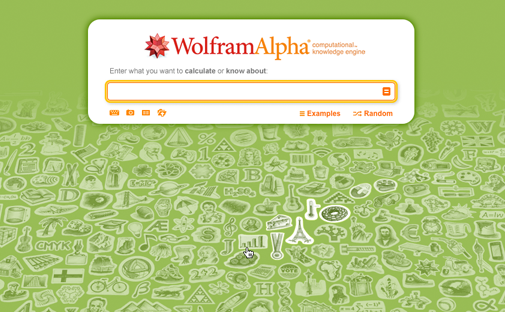
We’ve gone through our Examples page and illustrated some of our favorite queries to provide our users with a brand new way to experience Wolfram|Alpha and learn interesting facts. Each of the nearly 300 custom sketches refers to just one example taken from Wolfram|Alpha’s vast knowledge base, and clicking one will take you directly to a corresponding results page. This not only allows visitors to easily explore a wide variety of knowledge, but it also acts as an interactive starting point for those looking to learn more about the answers Wolfram|Alpha can provide.
More »
1
Imagine you are building a roller coaster. You need to create a curved shape for the track, which will be designed on a computer before being built out of metal. You want a curve that is fun to travel along, which means you want a lot of sharp curves—but not too sharp, unless you want your amusement park guests to get sick or pass out.

A similar consideration is faced by engineers building a railroad or a highway: you want the path of the road to have curves that are not too sharp—in this case, to prevent the cars or trains from having to slow down (reducing efficiency) or even to wreck. The reason, of course, is that when you travel along a strongly curved section of track or road, you feel an acceleration. The higher the curvature, the stronger the acceleration, all other things being equal. However, the acceleration you feel depends on how fast you are going along the track (the faster you go, the greater the acceleration), while curvature is a property intrinsic to the track itself.
More »
1
Today is the summer solstice—when the Sun is at its more northern point—which marks the first day of summer, as well as the longest day in 2012. It’s a great day to go outside and take advantage of all the extra sunlight, and also a good time to take a look at all of the computations Wolfram|Alpha can do revolving around the Sun.
Here in Champaign, Illinois, the sun rose at 5:25am this morning, with sunset happening at 8:27pm. This equals just over 15 hours of sunlight:
 6
6
It’s usually in precalculus class that students are first exposed to the more exotic and subtle aspects of functions on the real line. This first exposure comes through studying limits and discontinuities.
Most functions that we see every day, from the parabolic arc of a thrown ball to the exponential growth of money in a bank account, are “continuous.” That is, they don’t change their value suddenly. Thought of another way, a continuous function is one you can graph without having to lift your pen up from the paper.
Conversely, a discontinuity of a function is a point where the value of the function experiences a sudden change. In technical language, a discontinuity of a function from reals to reals is a point where either the left- or right-hand limit does not exist, or where these limits exist but aren’t both equal to the value of the function at this point.
Wolfram|Alpha now has the ability to find and analyze the discontinuities of most functions of real numbers. When it comes to such functions, there are three main kinds of discontinuities.
An “infinite” discontinuity is a point where the function increases to infinity and/or decreases to negative infinity (i.e., where it has a vertical asymptote). 1/x is the standard example:
 4
4
Wolfram|Alpha is different from most of the tools out there on the web that you might use to get answers. Rather than inundate you with lists of links to web pages that may or may not be useful, Wolfram|Alpha works to understand your query.
What really sets these different approaches apart is how they deal with complexity in queries. Whether there are many concurrent factors to your question or you have a unique math computation with an answer that simply does not exist on some web page, Wolfram|Alpha is your best bet for a web service that actually understands what you are asking.
One of the ways that complexity can appear in queries is in depth, when there are multiple steps to a question. To understand what we mean by “depth,” think of the beautiful Matryoshka dolls that all fit inside of each other.
To answer a query like “elevation of Steven Spielberg’s birthplace“, the first step is to recognize that “Steven Spielberg” and “birthplace” can be combined to form a location.
(elevation) of ((Steven Spielberg’s) (birthplace))
1
In our first post on American Community Survey estimates in Wolfram|Alpha, we showed you how Wolfram|Alpha could answer questions about the age and sex of the population in practically any town or region in the United States. But that’s only a small fraction of what we can do with this wealth of detailed demographic data. Over the next few weeks, we’ll also share some examples of how Wolfram|Alpha can help you find and analyze information about education, income, and more.
But first, let’s take a look at two of the most frequently asked for demographic topics in Wolfram|Alpha: race and Hispanic origin. If you’ve never done so before, it’s worth taking a moment to brush up on the difference between these two concepts, in Census terminology. Although people often lump the two concepts together, race and Hispanic origin are two completely separate attributes in Census data: a person can be of any race and also be of Hispanic or non-Hispanic origin. Even with the basic data we’ve had in Wolfram|Alpha since its launch, people have regularly complained that our numbers “don’t add up”—and it’s always because they’ve added Hispanic population estimates to figures for the population by race and ended up with a figure larger than the country’s total population.
More »
In astronomy, one of the most prized pieces of data is to determine the distance to an astronomical body. Prior to the sixteenth century, the distance between planets and the Sun was an educated guess, but an accurate value had not been determined. Without the ability to pace off the distance or use a physical measuring stick, there was no direct way to determine this. How far was the Earth from the Sun? The distance between the Earth and Sun, known as an astronomical unit, was a key piece of missing data. In 1761, one of the first international scientific endeavors was carried out. Ships carrying scientists from numerous countries were dispatched to various observation locations to observe a relatively rare event. The planet Venus was going to pass between the Earth and the Sun, and, from our point of view, would move across the solar disk.
 2
2
I was a child of the late 70s and early 80s, so I was witness to the early evolution of home computers and the trends that came along with them. It’s amazing when you see the large-screen displays of today and compare them to the giant bulky monitors from those early days. It’s also amazing to see how the capabilities of these displays have improved with time, something we often take for granted. We are spoiled with giant widescreen monitors that sometimes exceed 2500x1400 pixels in size. I remember taking my first steps in computer science in school using graphics on an Apple IIe that supported 280x192 pixels! (We also walked to school uphill both ways in the snow with no shoes, because those were a luxury.) I’m sure there are those of you in the audience who remember even earlier days with even more primitive capabilities (TRS 80?).
Today there are a high number of devices that support all manner of display resolutions. Many applications that deal with graphics will often present you with dialog boxes when you save your images that give you things like a pixels per inch (PPI) setting as well as the memory used by the image. Often these little things are taken for granted, but they can be useful for planning how to use your results. Wolfram|Alpha has now added some extensions to its functionality that provide some basic tools to help in this area.
Let’s start simple. A fairly common display size (maybe on the low end by today’s standards) is 1024x768 pixels.
More »
May 20–22 has held many major milestones in the history of aviation. Charles Lindbergh began the world’s first nonstop solo flight across the Atlantic Ocean on May 20, 1927 (and completed it one day later). Just five years after that on May 21, 1932, Amelia Earhart began her one-day journey across the Atlantic Ocean. Of course, those moments wouldn’t have been possible without the Wright Brothers patenting their airplane on May 22, 1906.
We’ve blogged in the past about the aviation functionality that Wolfram|Alpha knows. The query “flights overhead” is quite popular, but it only scratches the surface of what we can do.
While your friends or family are preparing to drive to the airport to pick you up, give them the name of your airline and flight number, and they can track exactly where you are in the air. Plus, they’ll see details on the scheduled departure and landing, actual departure and landing, air speed, altitude, and more.
 1
1
Solar eclipses have been recorded since ancient times, often misunderstood by early observers as a dragon eating the Sun or some omen of things to come. Although we have learned the true nature of eclipses in modern times, they never cease to amaze astronomers and the public alike. You can visualize solar and lunar eclipses using a Wolfram Demonstration.
Solar eclipses happen when the Moon moves between the Earth and the Sun. The Moon blocks the Sun’s light, which puts a kink into our daily expectations, making it get dark during the day. A fuzzy estimate puts the frequency of total solar eclipses at about one or two per year. This number can vary quite a bit. Often, these eclipses are only visible along narrow paths that are in out-of-the-way places that make it difficult for them to be observed (e.g. over the open ocean). Cruise ships are often booked for the sole purpose of chasing these solar eclipses for those people willing to set sail and pay the money to do so.
On May 20 of this year, people in the western United States and Pacific Ocean islands will be in a position to observe one of these solar eclipses without having to travel on the high seas.
 2
2
The world of colors is a tremendously interesting and diverse area, and accordingly, queries on colors have been some of the most popular and recurring queries in Wolfram|Alpha since its launch. In accordance with the popularity of the domain, we have recently performed a major upgrade to the existing color functionality in Wolfram|Alpha.
Let’s start with something basic: green. In addition to the color’s alternative notations, Wolfram|Alpha provides the nearest representations in various color spaces, including HSV, HSL, HSI, XYZ, xyY, Lab, and Luv:
 4
4
When Wolfram|Alpha launched three years ago, it did so with broad (but not very deep) socioeconomic data for most geographic places on Earth. Since then, each enhancement of this part of our knowledge base has tended to address just one type of place at a time. Sometimes we’ve added an entirely new category (like US congressional districts or school districts); other times, we’ve added a narrowly focused set of properties to an existing category (such as age pyramids for countries or home prices for US metro areas).
I’ve been proud of each of these individual features, but also frustrated by how hard it’s been to get detailed and directly comparable data for many different types of places at once—the kind of data, in other words, that Wolfram|Alpha is perfectly suited to work with.
But thanks to the outstanding work of our friends at the US Census Bureau, we’ve been able to take some big steps toward filling this “data gap.” The annual American Community Survey (ACS) is designed to replace the old long-form decennial census questionnaire, covering information about age, sex, race, ethnicity, education, income, and much more. In 2006, the Census Bureau released the first single-year ACS estimates, but only for areas with populations over 65,000; in 2008, three-year estimates came out for areas with populations of 20,000 or more; and in 2010, the first five-year estimates were released, covering every geographic area in the country.
More »
4
Since its creation, Wolfram|Alpha has constantly grown to cover more and more topic areas. Now, it includes some functionality that may be useful for people interested in lumber. Most of us are used to going into a local home improvement store and seeing large collections of construction lumber, but before it gets into those stores, it has to be cut from logs. An important step in the process is determining how much lumber can be obtained from a log of a given size. There is no single method for estimating this, but there are a number of empirical formulas that are commonly used to estimate the volume of lumber that can be obtained from a log given its diameter and length. Typically, these estimates are rounded to the nearest 5 or 10 board feet. Three of the most common empirical rules are the Doyle Rule, the Scribner Rule, and the International 1/4-inch log rule. Different regions tend to use different rules, so it’s up to users to decide which one they want to use.
 4
4
In spring 2011, while adding the finishing touches to my PhD dissertation, I decided to enroll in the Wolfram Science Summer School (then called the NKS Summer School). I never suspected that my project at the Summer School would lead to a job and my involvement in one of the central features of Wolfram|Alpha Pro.
During my years as a graduate student I had the chance to live in three different countries and experience different working environments: other than my native Italy, I lived in Paris, where my PhD was based at ENS, and in Princeton, where I was lucky enough to spend time at the Institute for Advanced Study. However, at the end of my PhD, I felt that most of my interest in what I was doing was gone and that I needed to try something new.
Once at the Summer School, I had the chance to meet and chat with Stephen Wolfram as he helped me come up with a problem to work on. One of the first things I told him was that I was weary of open-ended academic kinds of problems and I was afraid no one was ever going to read my papers. I said that I wanted to deal with intellectual challenges, but I also wanted to tackle something that had a clear beginning and end. More »
1
For the past few years, Wolfram Research has supported Bike to Work Day by handing out fruit, water, snacks, and other items to bikers at a station right outside our headquarters in Champaign-Urbana, Illinois. This year we decided to include some data about biking to work alongside the granola bars and bananas.
If you live in a bike-friendly area, you can save quite a bit of money each year by occasionally biking to work. Using the widget below, you can enter your daily commute in miles, how many days of the week for how many weeks of the year you expect to bike to work, and the MPG of your car and your city to determine how much money you can save.
3
It sounds like the setup for a stereotypical horror movie, but it’s a true story: a lone traveler—the founder of a major software company and the creator of an innovative computational knowledge engine—driving on a dark and unfamiliar road. A rental car running low on gas. It’s the 21st century, of course, so he’s got GPS—but the last few gas stations it directed him to were shuttered for the night. Should he take his chances with the next station recommended by the GPS? Should he pull over on a spooky, moonless country road and try to call other stations in the desperate hope that someone answers his call?
Well, maybe. Or he could just ask the Wolfram|Alpha iPhone or Android App “Where’s the nearest open gas station?”
 4
4
Who says data doesn’t have a lighter side to it?
Here at Wolfram|Alpha we are constantly adding data from the critical domains of science and socioeconomics and making all of it computable in order to provide new insights as well as novel ways of looking at the world we live in.
But once in a while we like to throw in something fun and exciting, and one such new area that we have added is detailed information on over 150 types of keyboards from all over the world. Ever wondered how many keys are on the third row of a US keyboard or what fingers you would use when typing the first six words of the Gettysburg Address, “Four score and seven years ago”, on your keyboard?
 11
11
Today marks an important milestone for Wolfram|Alpha, and for computational knowledge in general: for the first time, Wolfram|Alpha is now on average giving complete, successful responses to more than 90% of the queries entered on its website (and with “nearby” interpretations included, the fraction is closer to 95%).
I consider this an impressive achievement—the hard-won result of many years of progressively filling out the knowledge and linguistic capabilities of the system.
The picture below shows how the fraction of successful queries (in green) has increased relative to unsuccessful ones (red) since Wolfram|Alpha was launched in 2009. And from the log scale in the right-hand panel, we can see that there’s been a roughly exponential decrease in the failure rate, with a half-life of around 18 months. It seems to be a kind of Moore’s law for computational knowledge: the net effect of innumerable individual engineering achievements and new ideas is to give exponential improvement.
 30
30
For hundreds of years, scholars have carefully studied the plays of Shakespeare, breaking down the language and carefully dissecting every act and scene. We thought it would be interesting to see what sorts of computational insights Wolfram|Alpha could provide, so we uploaded the complete catalog of Shakespeare’s plays into our database. This allows our users to examine Romeo and Juliet, Macbeth, Othello, and the rest of the Bard’s plays in an entirely new way. More »
16
One of the features of calculus is the ability to determine the arc length or surface area of a curve or surface. An arc length is the length of the curve if it were “rectified,” or pulled out into a straight line. You can also think of it as the distance you would travel if you went from one point to another along a curve, rather than directly along a straight line between the points.
To see why this is useful, think of how much cable you would need to hang a suspension bridge. The shape in which a cable hangs by itself is called a “catenary,” but with a flat weight like a roadway hanging from it, it takes the shape of a more familiar curve: a parabola.
 4
4
We’re constantly expanding Wolfram|Alpha’s knowledge base in small ways. Sometimes we know from the start that a new feature is going to be “blog-worthy,” like pro football stats or live aircraft-tracking data. Lots of other additions are useful, but don’t seem worth crowing about too loudly. We recently added some data on each of the 94 district courts of the US federal court system, and I confess that it seemed like a project in the latter category—but it turned out to reveal some genuinely fascinating bits of information about the justice system in this country.
Most people probably don’t have a natural sense of the jurisdiction of each court—or even how many there are in their state—but an input like “California courts” will give you a summary of key stats about all the district courts in a given state, including a list of the largest cities in each of them. From there, you can click a specific court to see a map of that court’s jurisdiction and detailed information about overall caseloads and judgeships, as well as annual filings for a variety of civil and criminal case types.

It’s spring and I am ready for it. In the last few years I have come to love gardening and the general outdoors more so than I ever have in the past. Something about spending time in the warm sunlight, getting your hands dirty, and being in touch with nature is relaxing. I’ve found myself paying more attention to many green things around my yard that I would have previously just dismissed as a “weed.” Now I find that many of these things are not only beneficial, but in some cases edible. We at Wolfram|Alpha recently decided that we needed to beef up our plant coverage to include more than just, primarily, taxonomic information. Wolfram|Alpha now makes use of data from the USDA that includes information, mainly qualitative, that gardeners and botanists might find more useful. More »
1
We’ve posted before about Wolfram|Alpha’s ability to answer questions about US school districts and individual public schools, and you’ve given us a lot of great feedback—and even more requests to expand and enhance our school coverage.
We’ve made a few significant improvements in recent months, including the addition of nearly 30,000 private schools to Wolfram|Alpha’s knowledge base. More »
8
The latest version of our Wolfram|Alpha App for iOS just hit the iTunes App Store, and it comes with some exciting new features! Alongside visual upgrades to weather queries and the addition of links to purchase consumer products directly from Best Buy comes the biggest upgrade to our mobile app yet: using images as input.

With an in-app purchase of $0.99 comes the ability to use photos from your Camera Roll or pictures taken on the fly and input them directly into Wolfram|Alpha. Wolfram|Alpha can then provide analysis of your photo, add filters, detect features, perform color processing, and apply image effects. More »
1
At about 6pm CST on March 6, there was a very powerful X 5.4 solar flare. This triggered a coronal mass ejection (CME). Indications were that the CME wasn’t squarely directed at Earth, but that a strong glancing blow to the Earth’s magnetosphere was possible. Here’s the data in Wolfram|Alpha for the flare:

There are two X-class flares during this time range. The effects of the first flare hit the Earth on March 7 and was a minor glancing blow, but caused a geomagnetic storm with effects visible in northern latitudes. More »
7
In continuing our goal to create “An App for Every Course, and More”, we are happy to announce the latest in our Course Assistant series of iOS apps: the Wolfram Linear Algebra Course Assistant. Powered by Wolfram|Alpha, the Wolfram Linear Algebra Course Assistant will help you work your way through homework problems, ace your tests, and gain a better understanding of linear algebra concepts!
 7
7
(Update: You can now find this data in the Wolfram Cat Breeds Reference App for iOS.)
Famed amateur astronomer David H. Levy once stated, “Comets are like cats; they have tails, and they do precisely what they want.” I’m a cat person and this seems to fit. Comets have a somewhat unpredictable nature to them, making it nearly impossible to determine how they will perform from one apparition to the next. This seems like a fitting description of cats as well, based on personal experience with my three cats. After recently diving into data on dog breeds, the natural next step would be to explore cat breeds.
Cat fancy is a rather popular activity, perhaps only slightly less popular than dog competitions. As with dog breeds, there are a number of accepted breeds that take part in competitions. We have gathered data from Cat Fanciers’ Association (CFA) and The International Cat Association (TICA) along with other sources to provide coverage on a majority of cat breeds.
 2
2
I get to show off the power of Wolfram|Alpha, Mathematica, and our other technologies to lots of interesting people, but last Friday was more interesting than usual, as David Cameron, the UK Prime Minister, came to our European headquarters.

United Kingdom Prime Minister David Cameron with Conrad Wolfram
1
The 2012 Academy Awards will be broadcast this Sunday, and once again Wolfram|Alpha can help you settle all sorts of Oscar-related arguments, generate some cool trivia questions for your Oscar-night party, and do a few fun new tricks you probably didn’t know about.
Consider the list of 2012 best picture nominations, for example. Even among the front-runners for this year’s statuette, there’s a pretty big spread in general popularity and box office performance. How big? Ask Wolfram|Alpha to compare box office for Moneyball, Hugo, The Artist, and The Help, and you can see that The Help has earned more than twice as much as Moneyball and more than 6 times as much as The Artist (which has 10 nominations this year, versus 4 for The Help). More »
9
Wolfram|Alpha has been steadily growing since its initial release nearly three years ago, and this growth is directed, in part, by the queries it receives. For example, the Wolfram Education Portal was created largely in response to the obvious demand for Wolfram|Alpha in the classroom. As a more specific example, we’ve recently enabled Wolfram|Alpha to respond to domain and range queries for real functions.
The domain of a real function is the set of real numbers that can be plugged in so that the function returns a real value. If, for example, we wish to evaluate f(x) = √(x + 2) / (x – 1), then we should ensure that x + 2 > = 0 and x – 1 ≠ 0:
 3
3
Are you looking for a great way to spend your summer? We are happy to announce the Mathematica Summer Camp 2012! Held at Curry College in Milton, Massachusetts, students will have the opportunity to learn Mathematica’s language, apply their skills in other disciplines, and program their very own Wolfram Demonstrations! Students will also work individually and in groups to hone their Mathematica skills.

This unique, two-week overnight camp is designed for students entering their junior and senior years in high school. We look forward to seeing all the most talented high school students at camp this year! More »
5
(Update: You can now find this data in the Wolfram Dog Breeds Reference App for iOS.)
Since prehistoric times, mankind has kept certain animals nearby for companionship, assistance in hunting tasks, and defense. Dogs are probably the most well-known examples of companion animals. This habit has continued to modern times and has resulted in a high number of dog breeds created for a variety of purposes. One modern convention is the concept of dog competitions. With the 2012 Westminster Kennel Club Dog Show beginning today (more on this below), we thought this would be a good time to highlight some of the information Wolfram|Alpha has to offer concerning dog breeds:
 16
16
It’s a sad but true fact that most data that’s generated or collected—even with considerable effort—never gets any kind of serious analysis. But in a sense that’s not surprising. Because doing data science has always been hard. And even expert data scientists usually have to spend lots of time wrangling code and data to do any particular analysis.
I myself have been using computers to work with data for more than a third of a century. And over that time my tools and methods have gradually evolved. But this week—with the release of Wolfram|Alpha Pro—something dramatic has happened, that will forever change the way I approach data.
The key idea is automation. The concept in Wolfram|Alpha Pro is that I should just be able to take my data in whatever raw form it arrives, and throw it into Wolfram|Alpha Pro. And then Wolfram|Alpha Pro should automatically do a whole bunch of analysis, and then give me a well-organized report about my data. And if my data isn’t too large, this should all happen in a few seconds.
And what’s amazing to me is that it actually works. I’ve got all kinds of data lying around: measurements, business reports, personal analytics, whatever. And I’ve been feeding it into Wolfram|Alpha Pro. And Wolfram|Alpha Pro has been showing me visualizations and coming up with analyses that tell me all kinds of useful things about the data.
 71
71
Today I’m excited to be able to announce the launch of Wolfram|Alpha Pro—the biggest single step in the development of Wolfram|Alpha since its original introduction.

Over the two and a half years since we first launched, Wolfram|Alpha has been growing rapidly in content and capabilities. But today’s introduction of Wolfram|Alpha Pro in effect adds a whole new model for interacting with Wolfram|Alpha—and brings all sorts of fundamentally new and remarkable capabilities.
Starting today, everyone has access to Wolfram|Alpha Pro at wolframalpha.com. Unlike the “tourist” version of Wolfram|Alpha, though, you have to log in, and, yes, to get full capabilities there’s a subscription ($4.99/month, or $2.99/month for students). (Right now, you can try it for free with a trial subscription.)
So, what does Wolfram|Alpha Pro do?
 38
38
Remember that New Year’s resolution you made to lose weight this year? If you’re one of the many people around the world who pledged to get healthy and finally lose that weight, Wolfram|Alpha is here to help! Even with January behind us, there is still plenty of time to get back on track in 2012.
Studies throughout the decades have shown that regular diet and exercise is the number-one way to get healthy. Wolfram|Alpha can offer you a variety of different ways to start, track, and maintain your new healthy lifestyle.
Query how to lose weight, and Wolfram|Alpha will bring up a formula where you can enter all the information needed, including your intended physical activity level, to figure out how many calories you should be eating every day in order to reach your target body weight:
 3
3
Over the past few weeks, we’ve highlighted a ton of different ways that Wolfram|Alpha can help you explore and analyze NFL statistics. Neither team has a perfect record at stake in this weekend’s Giants-Patriots Super Bowl, but it still promises to be a tough contest and a typically over-the-top cultural experience—so in our final blog post of the 2011 NFL season, we’d like to suggest a few more useful stat queries, as well as some more unusual ways to use Wolfram|Alpha on Super Bowl Sunday.
First, the stats. The Giants won their regular season clash with the Patriots this year, and with the new game-level history plots we just added to team and player results, you can clearly see that the Giants’ defense put the pressure on Tom Brady that week, holding his passer rating to its lowest point of the season:
 86
86

Most of our users are aware that we release a new version of Wolfram|Alpha every week. Each version includes countless changes—including regular data updates to hundreds of sources, improvements to our natural-language parser and other core frameworks, and completely new areas of coverage. More »
One year ago this week we sent out our first Wolfram Fun Fact! Since then, we have tweeted nearly 200 Wolfram|Alpha-computed facts, gained over 10,000 followers, and received some pretty amazing submissions from those followers.
To celebrate our first birthday, we thought we would share some of our favorite and most popular Wolfram Fun Facts from the past year:
round(log_12(vitaminC in a cubic light year of coffee/kg)))= meaning of lifehttp://bit.ly/hl98zt #FunFact— Wolfram Fun Facts (@WolframFunFacts)March 16, 2011
18
Wolfram|Alpha has become well-known for its ability to perform step-by-step math in a variety of areas. Today we’re pleased to introduce a new member to this family: step-by-step differential equations. Differential equations are fundamental to many fields, with applications such as describing spring-mass systems and circuits and modeling control systems.
From basic separable equations to solving with Laplace transforms, Wolfram|Alpha is a great way to guide yourself through a tough differential equation problem. Let’s take a look at some examples.
Wolfram|Alpha can show the steps to solve simple differential equations as well as slightly more complicated ones like this one:
 2
2
If you paid any attention to last weekend’s NFL games, you know that we’re headed for another Patriots versus Giants Super Bowl. We’ll take a closer look at those two teams next week, including prior matchups, head-to-head player comparisons, and performance trends over the past few months. But while we’ve got a slight breather in the NFL schedule, we wanted to show you a few ways you can use Wolfram|Alpha to uncover interesting stats from the 2011 NFL season (and beyond).
The Indianapolis Colts turned from a possible playoff contender to a team just hoping to win a game after quarterback Peyton Manning was ruled out for the year. Manning’s absence was a big reason why the Colts’ offense had a hard time scoring points. This bar graph clearly shows the Colts having the lowest point production since 1993.

What rule gives the integer sequence 3, 10, 17, 18, 7, …? Wolfram|Alpha can easily find that this sequence comes from a simple cubic polynomial, –x3 + 6x2 – 4x + 2.
A different sequence, 1, 1, 3, 7, 22, 82, 333, 1448, … can be identified as the sequence of the polyhexes. After that, the input sequence of the polyhexes recovers the above sequence.
More »
1
Last week we announced our partnership with global sports statistics company STATS LLC and demonstrated how Wolfram|Alpha now allows users to access and compute football statistics using natural language. Since our original announcement, we’ve had a weekend’s worth of exciting playoff games. Miss any of the action? Ask Wolfram|Alpha about last weekend’s NFL games. Wolfram|Alpha not only returns the games and their final scores, but also provides a summary of team statistics leaders (and losers) across all four matchups. More »
9

Teachers, are you looking for a new way to integrate technology into your classroom? How about through a dynamic textbook or pre-generated lesson plans? Students, are you looking for some extra help or practice in your classes? How about using interactive demonstrations and widgets to help understand the concepts you are learning? The Wolfram Education Portal is the answer for students and teachers alike!
We are happy to announce the launch of the free Beta version of the Wolfram Education Portal. The portal comes equipped with a dynamic and interactive textbook, lesson plans aligned to the common core standards, and many other supplemental materials for your courses, including Wolfram Demonstrations, widgets, and videos. The Education Portal currently contains full materials for Algebra and partial materials for Calculus, but will continue to grow and improve with your comments and feedback. More »
3
Since Wolfram|Alpha launched in 2009, we’ve often said that its knowledge base covers what you’d find in a pretty good reference library—and many of the new features we’ve highlighted over the past two and a half years have indeed been very reference-y: global agriculture data, public school statistics, species information, and tons of other socioeconomic, scientific, and mathematical content. Of course, Wolfram|Alpha has always been much more than a mere repository of reference data: we’ve made it possible for people to explore, compare, compute, and interact with all that data in unprecedented ways. More »
7

There’s been very little change in top-level internet domains (like .com, .org, .us, etc.) for a long time. But a number of years ago I started thinking about the possibility of having a new .data top-level domain (TLD). And starting this week, there’ll finally be a period when it’s possible to apply to create such a thing.
It’s not at all clear what’s going to happen with new TLDs—or how people will end up feeling about them. Presumably there’ll be TLDs for places and communities and professions and categories of goods and events. A .data TLD would be a slightly different kind of thing. But along with some other interested parties, I’ve been exploring the possibility of creating such a thing.
With Wolfram|Alpha and Mathematica—as well as our annual Data Summit—we’ve been deeply involved with the worldwide data community, and coordinating the creation of a .data TLD would be an extension of that activity. More »
3
Finding the tangents and normals of a mathematical function or relation is one of the most common exercises in any calculus course. In this post, I’ll show you the newest functionality in Wolfram|Alpha for discovering and investigating them.
The simplest example of a tangent is the “tangent line” to a one-dimensional curve in the plane. Graphically, the tangent line is a line that “just touches” the curve at some point, so that if it were moved just slightly, this one point of contact would become two.
If you ask Wolfram|Alpha for the tangent line of a specific function and point, it gives it in both graphical and algebraic/numerical form:
 4
4
The next time you go stargazing, bring the power of computation along with the Wolfram Planets Reference App and Wolfram Stars Reference App for iOS. Both apps provide access to real-time data and the computational power of Wolfram|Alpha in order to perform advanced calculations and provide data on the planets and stars.

 7
7
What do your alarm clock, thermostat, coffeemaker, car radio, anti-lock brakes—and almost every other electrical and mechanical device you encounter in your daily life—all have in common? They are all examples of “control systems,” one of the most ubiquitous yet unseen modern technologies. A control system is any system or device that controls or regulates the behavior of another system. Using various kinds of sensors and actuators, these systems automatically control most common appliances, industrial processes, and even your body’s own biological processes!
Take your home’s humble thermostat. The temperature of your home depends on many factors, especially how long and how recently the home’s furnace was on. With a thermostat installed, the reverse is also true: the state of the furnace depends on the temperature of the house (it comes on if the temperature is too low, and turns off if the temperature is too high). There is a closed loop of causation formed between the home’s temperature and the state of the furnace. By design, the thermostat creates a kind of closed loop called a “negative feedback loop,” which tends to stabilize the temperature around a desired value. Most control systems are like this: sensors feed information back into the system, which is then used to decide on an action. More »